
About TalentQuill
Most organisations are investing in AI — tools, subscriptions, training — without a reliable way to know whether it's working.
They can measure sales performance, coding output, and communication skills. But AI fluency, arguably the most consequential competency of this era, gets treated like a feeling. Companies assume their teams are adapting. They rarely know.
TalentQuill was built to close that gap.
We measure AI fluency against four dimensions of judgment that describe what a professional actually does when AI is part of their work. Our proprietary framework rests on one insight that shapes everything else: what it means to work effectively with AI looks fundamentally different depending on what you do. A finance analyst and a product manager face different AI imperatives. They should be assessed accordingly.
TalentQuill is built for organisations that have adopted AI tools but lack the knowledge and tools to measure its impact.
Our Mission
To give every business leader the knowledge, tools and data they need to build an AI-ready workforce that delivers on the promise of AI productivity.
Meet the founders
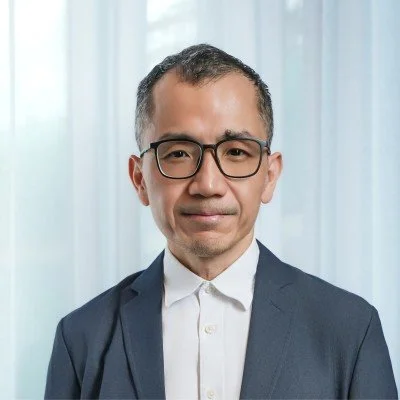

Stephen Tracy
Co-founder & Chief Experience Officer (CEO)
Stephen spent years building and leading data teams inside large global agencies, including Publicis, IPG (now part of Omnicom Group) and YouGov Plc. He’s also co-founded multiple companies, including Milieu Insight, one of Southeast Asia’s fastest growing research technology companies.

Dr. Gary Ang
Co-founder & Chief Thinking Officer (CTO)
Gary Ang led AI risk supervision at the Monetary Authority of Singapore, where he developed Singapore's first AI risk management guidelines for the financial sector. He was previously division head for investment risk management, overseeing risk management of Singapore's foreign reserves. He currently trains for, or partners with institutions such as the Monetary Authority of Singapore, the Association of Banks in Singapore, Singapore College of Insurance, Wealth Management Institute, Toronto Centre and Cambridge Centre for Alternative Finance. He also sits on sits on Rutgers Business School's Masters of Quantitative Finance Advisory Board. He holds a PhD in Computer Science. His research focused on deep learning for networks, time series, and multimodal data, and he has published at leading venues including ACL and ACM conferences. He has also published recent papers on AI governance and risk management, as well as AI and workforce transformation. He also holds Masters degrees in Financial Engineering and Knowledge Engineering from NUS, and is a LinkedIn Top Voice on AI.